
Keep caring: A short guide to modernizing legacy systems
Our writing
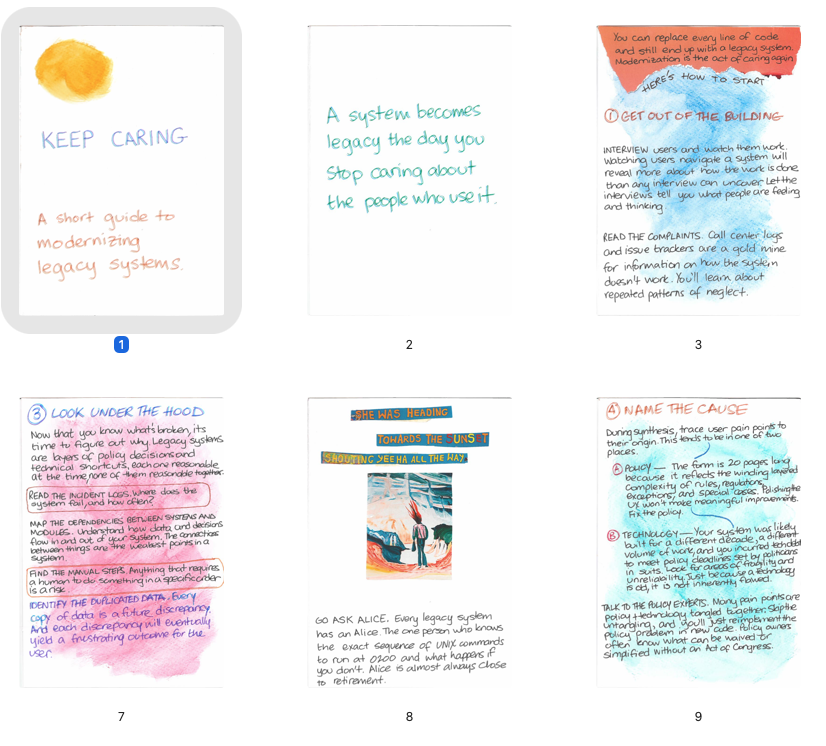
A short guide to modernizing legacy systems. You can download it as a PDF or read the text online.
A system becomes legacy the day you stop caring about the people who use it.
You can replace every line of code and still end up with a legacy system. Modernization is the act of caring again. Here’s how to start.
1. Get out of the building
Interview users and watch them work. Watching users navigate a system will reveal more about how the work is done than any interview can uncover. And interviews will tell you what people are feeling and thinking.
Read the complaints. Call center logs and issue trackers are a gold mine for information on how the system doesn’t work. You’ll learn about repeated patterns of neglect.
Look at the analytics. Analytics tell you where users get frustrated or confused and if they are looking for more information.
Find the spreadsheet. Somewhere in a legacy system is a spreadsheet, group chat, or a single person who represents the workarounds. Workarounds are how the system actually works.
You should use AI to synthesize the interviews, investigate the call logs, and cluster the complaints. However, AI can not take a ride with a caseworker and notice the sticky note on their dashboard. Hang with the caseworker.
2. Measure what matters
How will you know whether your modernization worked? Start by identifying the one metric that matters the most: The single number that means it was all worth it. Then pick one or two more.
- Did the benefit reach the person who needed it? (Applications approved)
- Did the applicant get an answer before the rent came due? (Days to decision)
- Did people finish without needing support? (Percent who complete without asking for help)
Test every decision against metrics.
If you’re not improving outcomes as part of your modernization, you’re just redecorating.
3. Look under the hood
Now that you know what’s broken, it’s time to figure out why. Legacy systems are layers of policy decisions and technical shortcuts, each one reasonable at the time, none of them reasonable together.
Read the incident logs. Where does the system fail, and how often?
Map the dependencies between systems and modules. Understand how data and decisions flow in and out of your system. The connections between things are the weakest points in a system.
Find the manual steps. Anything that requires a human to do something in a specific order is a risk.
Identify the duplicated data. Every copy of data is a future discrepancy. And each discrepancy will eventually yield a frustrating outcome for the user.

Go ask Alice. Every legacy system has an Alice. The one person who knows the exact sequence of UNIX commands to run at 2 am to start a batch job and what happens if you don’t. Alice is almost always close to retirement.
4. Name the cause
During synthesis, trace user pain points to their origin. This tends to be in one of two places.
Policy. The form is 20 pages long because it reflects the winding, layered complexity of rules, regulations, exceptions, and special cases. Policy becomes complex over time. Polishing the UX won’t make meaningful improvements.
Technology. Your system was likely built for a different decade, a different volume of work, and you incurred tech debt to meet policy deadlines set by politicians in suits. Look for areas of fragility and unreliability. And remember that just because a technology is old, it is not inherently flawed.
Talk to the policy experts. Many pain points result from both policy and technology woes tangled together. Skip the hard work of untangling these, and you’ll faithfully reimplement policy problems in a new tech stack.
Policy owners often know what can be waived, simplified, or reinterpreted without an Act of Congress. Talk to them about the technology too. They’ve often been there longer than the system has, and they remember why it was built that way.
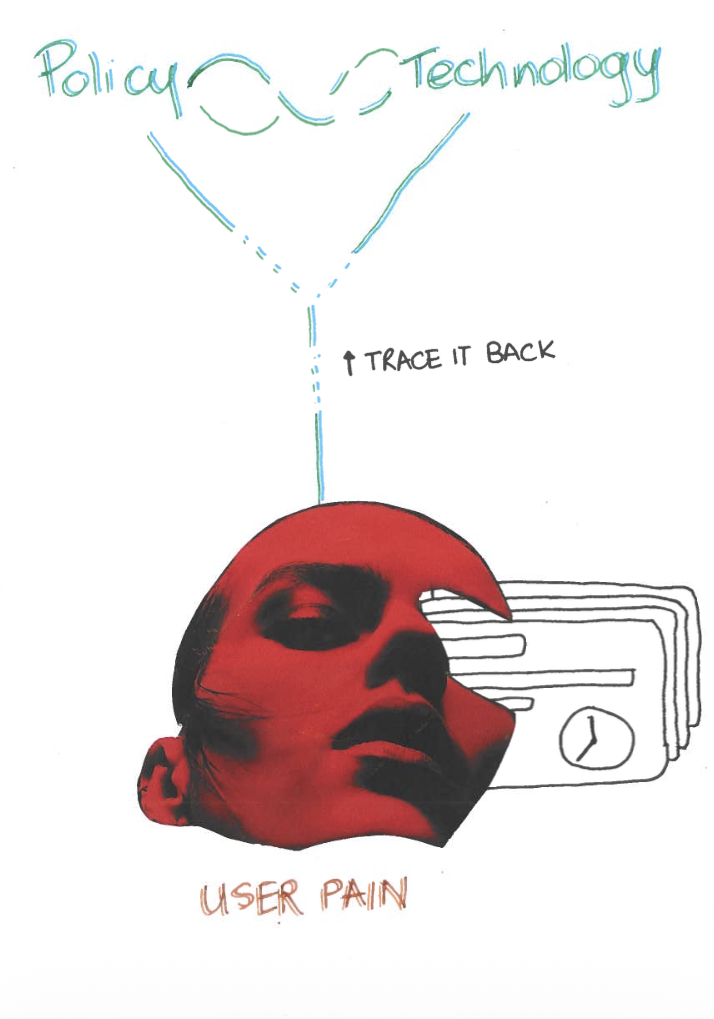
Fixing policy is slow and thankless work, but simpler policy will always yield better services.
5. Fix the right things first
Now, you’re ready to walk into prioritization with a list of specific problems to solve and outcomes to improve. Prioritization defines your modernization strategy, and you can’t fix everything at once. Your goal should be to fix the right things first.
Plot each problem along two axes.
- User value. How much does fixing this improve your outcome? How many people are affected and how badly?
- Complexity. How hard is this to change? How tangled is it with other systems? How well do you understand it?
Four quadrants fall out of that.
High-value, low-complexity. Start here. These problems are rarely glamorous, but they improve outcomes early.
High-value, high-complexity. Set aside some time to plan for these. They are worth doing, just not at first.
Low value, low complexity. These are easy but won’t improve meaningful outcomes. Do them when you have spare capacity.
Low value, high complexity. Don’t. This is where modernization budgets go to die.
Resist two instincts:
- Don’t choose the hardest, most technically interesting problem because it is the one your engineers want to solve.
- Don’t choose the loudest problem. This is the one the suit keeps bringing up in meetings because it feels urgent.
Neither of these is the same as high value. Let the grid decide. Early wins build the credibility to tackle harder problems later.
6. Keep caring
Too many modernization efforts are treated as a single, one-time push to course-correct past decisions. But your system needs to continuously support reality. Users needs shift and policies change.
Avoid these two common risks:
- Stalling: Once you’ve landed a win or two (high-value, low-complexity), attention moves elsewhere. The list of harder problems you planned for never gets touched because no one is asking for them anymore.
- Regression: Ignoring your users’ new needs can happen quietly. Needs can shift if you’re not actively paying attention.
Fight both with the same habit: continuous discovery.
Keep talking to users. Keep interviewing users, listening to complaints, and showing up wherever the caseworker is.
Report your metrics on a schedule. Share the trends, focus on what matters, and skip the vanity metrics.
Assume new workarounds exist. Find them before they stick.
Protect time for high-value, high-complexity work. This is the work that’s the hardest to keep momentum on. It’s not going to get done by accident. Make time for it.
A system stays modern for exactly as long as the organization keeps caring for the people who use it. That was true on day one. It’ll be true 20 years later.
Writing and Illustration: Shashank Khandelwal